




Key takeaways from Axtria Ignite 2026's panel on the future of promotional planning, featuring commercial and data science leaders from four leading pharmaceutical companies.
Executive Summary
- The bottleneck moved — from data to decisions. Promotional planning cycles that once took three to six months are compressing into hours — but the constraint has moved downstream, from producing insight to acting on it.
- Brand managers are becoming editors, not requesters. They are shifting from requesters of intelligence to editors of it; judgment, not access to data, is becoming the scarce skill.
- The real gap isn't measurement speed — it's decision cadence. The constraint is set by legal review timelines, media lead times, and governance, not dashboards.
- Portfolio autonomy is a governance problem, not an analytics problem. The math for optimizing spend across dozens of simultaneous launches already exists; what's unresolved is who decides, and how to stop brands cannibalizing each other's spend.
- Trust decides who scales, not the model. Explainability, not model accuracy, is what moves field adoption of next-best-action recommendations.
- Agentic AI is proving itself in simulation and support, not decisions. Its near-term value is faster what-if modeling and real-time field guidance, not autonomous promotional calls — and the last mile to the HCP or patient remains unsolved.
Here are key takeaways for commercial and brand leaders:
A pharmaceutical company that used to launch one product a year now expects to bring thirty or more assets to market in the next five years — on budgets that are not growing. That arithmetic, more than any algorithm, is what has broken the traditional model of promotional planning: a static campaign, built months in advance and left to run its course. Add a fragmenting omnichannel landscape and healthcare providers who now benchmark every interaction against the consumer AI tools they use outside of work, and the old model of promotional planning starts to look structurally out of date.
At Axtria Ignite 2026, senior commercial and data science leaders from four leading pharmaceutical companies, moderated by Axtria's Sameer Sardana, took on this shift directly. The conversation was notable less for its optimism about AI, which was assumed rather than argued, and more for its candor about where the friction sits now that the analytics have gotten fast. The consensus: the hard part of promotional planning is no longer producing the insight. It is what the organization does with it.
1. The Bottleneck Moved from Data to Decisions
Promotional planning has historically been a slow, sequential exercise. Building a plan for a pharmaceutical brand could take three to six months, moving through separate investment-planning and campaign-execution teams that rarely worked in tight coordination. AI is narrowing that gap by pulling structured inputs from disparate internal data sources into a single, faster process — bringing the team that decides how much to invest closer to the team that decides how to spend it.
The more consequential shift is what AI does with that speed. For two decades, analytics in the industry has functioned retrospectively, summarizing what already happened, faster and more cleanly each year. What is changing now is how analytics operates: rather than only reporting on past performance, systems are beginning to recommend, and in some cases act, on what should happen next. That raises a governance question every commercial leader must now answer for their own organization — not whether to trust AI, but when to let it run and when to override it with judgment.
“What we have done mostly is probably setting up a rear-view mirror. We always look back at what happened. Now, I believe, AI will probably get us to a point where it's not just summarizing what happened. It'll probably also decide for us, even act on our behalf.” - Director of Data Science and Omnichannel, a Global Biotechnology Innovator
2. Brand Leaders Become Editors of Intelligence
Response modeling itself is not new; the discipline is roughly two decades old. What has changed is the marketer's expectation of how quickly it should arrive. Work that once required weeks of analyst time is now, in principle, a conversation away — an expectation set largely by tools outside the industry, since marketers already use general-purpose AI in their own lives and bring that same bar back to work.
“For the brand managers, I think the biggest thing that I see is instead of the requester of intelligence, they are becoming more like an editor of intelligence. They're not requesting it because they already have the information. They're putting it in a ChatGPT and saying, hey, what else can I do? So their judgment becomes more like an important aspect.” - Executive Director, a Global Eye Care Company
Another panelist framed the long-term destination in similar terms: less campaign manager, more brand strategist, governing agentic systems rather than operating them directly.
“The role of a commercial leader is changing significantly and will change in coming few years to be more of a brand strategist rather than a campaign manager. We will see agentic systems in play where these brand managers or commercial leaders are expected to leverage and govern these systems to speed up delivery.” - Senior Director of Data Science, a Global Biopharma Leader in Antiviral Therapeutics
3. The Real Gap Is Decision Cadence, Not Measurement Speed
It would be easy to assume the next lever is simply faster measurement. A panelist pushed back the assumption directly, reframing the problem as one of decision cadence rather than data speed.
“I think for us, the problem is not like having that measurement gap. Our problem is actually having a gap of that decision cadence. If you get the daily data from IQVIA and other data sources, what would that give you? Would that really buy you anything if your response time through MLR (Medical, Legal, Regulatory) is still going to be four weeks, or you still require a two-month advance lead time for media buys?” - Executive Director, a Global Eye Care Company
The operating principle the panel converged on: measurement should follow execution, not outpace it. Measure faster than the organization can act, and recommendations pile up unused; measure slower, and the business flies without instruments.
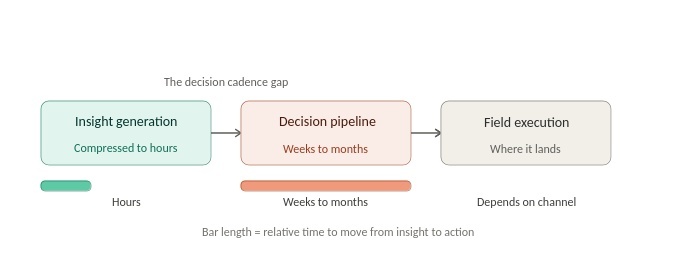 The bottleneck has moved downstream: insight generation now runs in hours, but the decision pipeline — medical, legal, and regulatory review; media lead times — still runs in weeks to months.
4. Autonomy Arrives Function by Function
Once portfolios span dozens of simultaneous launches, the central design question becomes how much autonomy each brand keeps. The analytics for portfolio optimization largely exist; what remains unsolved is governance — who decides, at what level, and how to stop multiple brands chasing the same customers with redundant spend.
“The number of launches in the pharmaceutical industry are accelerating. Typically, we used to have one product per year launches. Now somebody just said in their company, they are expected to bring like 30, 40 new assets in the market in the next five years. So the launch scale is just unprecedented.” - Executive Director, a Global Top-Tier Pharmaceutical Company
Across the promotional planning value chain, agentic AI is already earning its keep in some places and being deliberately held back in others.
“Portfolio optimization, I believe, is at the heart, taking away autonomy of the brand. The analytics part is already there. So it's the governance problem that we have to deal with — where are the spends going and probably spends from the same company going to the same place.” - Director of Data Science and Omnichannel, a Global Biotechnology Innovator
5. Trust is the Adoption Engine
Next-best-action programs have followed a familiar arc across the industry: rule-based, then predictive, now adaptive, with agentic versions still ahead. The panel was unusually direct about why early NBA programs underperformed — the issue was rarely the model. It was trust. Field reps did not reject recommendations because the underlying analysis was wrong; they ignored them because nothing explained why a given action showed up in their queue.
The fix has been explainability: pairing every recommendation with a clear, rep-friendly reason. Field adherence climbed once the program started communicating the why behind the what, in language reps use day to day.
“The most important difference between what we had earlier, which was a ‘what’-driven system, to a ‘why’-driven system, is explainability. Explaining why you are suggesting a recommendation is perhaps even more important than the recommendation itself, because you want to drive trust and provide transparency.” - Senior Director of Data Science, a Global Biopharma Leader in Antiviral Therapeutics
“Adoption was about 55, 60% with the adherence. Now we are at about 75%. And that happened only because we started clearly providing ‘why’ behind ‘what’ and in the language that our reps would understand.” - Executive Director, a Global Eye Care Company
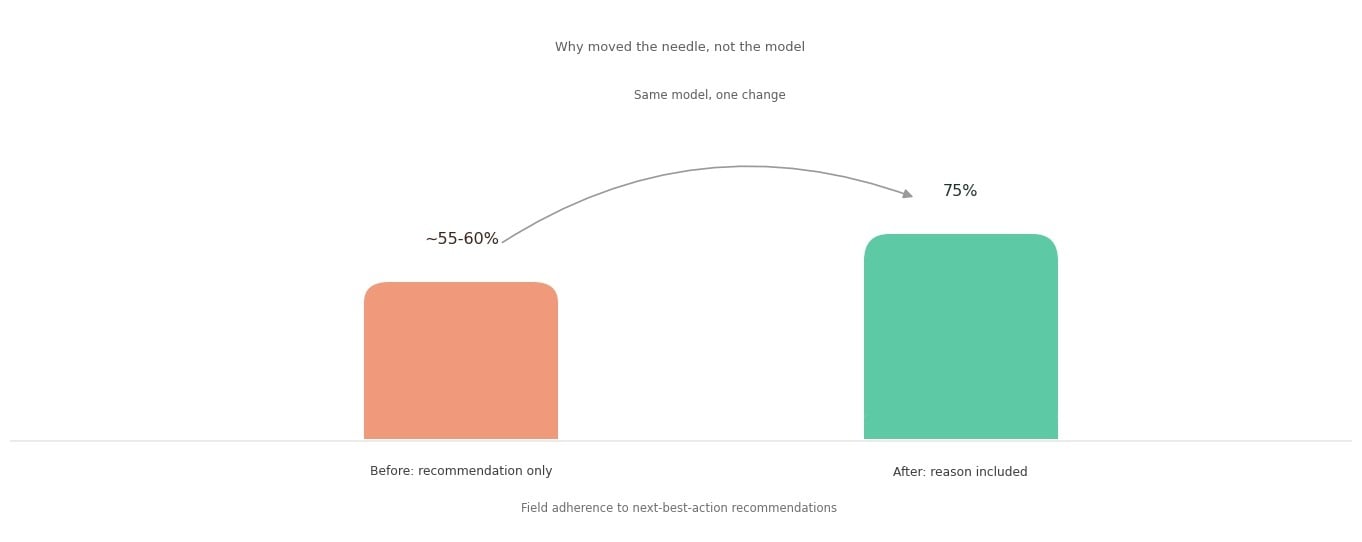 The recommendation engine stayed the same. Adding a clear reason alongside each next-best-action recommendation moved field adherence from the high-50s into the mid-70s.
6. What Agentic AI Can Do Now — and What It Still Can't
The panel was disciplined about near-term limits. Agents are not, today, making promotional decisions on their own. Their value lies elsewhere: running simulations fast enough for marketers to explore far more scenarios before committing and giving district managers the ability to fuse call notes, coaching reports, and performance data into real-time guidance without waiting on headquarters.
That value is not guaranteed simply by layering agentic AI onto existing omnichannel execution. The harder question is whether it genuinely improves the customer's experience or adds noise to an already crowded set of touchpoints. The ambition should be a single, orchestrated view of the entire provider or patient journey — including the non-promotional interactions that fill much of a physician's day — not optimization of the promotional slice alone.
“Agents are not going to make the promotional decision; I can tell you that right now. But what it would absolutely do is allow marketers to get more insight and run simulations — they can play with what-if scenarios a lot faster.” - Executive Director, a Global Eye Care Company
One panelist's caution was about what all of this is actually for:
“Is it truly maximizing the customer experience, or is it just going to add more noise to their experiences? It is not about the technology driving the outcome by itself but facilitating the customer experience and solving the needs of the customer and the business together.” - Executive Director, a Global Top-Tier Pharmaceutical Company
Asked to name one capability that isn't yet table stakes but will be within three years, no panelist reached for a new algorithm. One panelist named AI fluency across the organization. Another panelist named a well-governed semantic layer with metrics everyone understands. A third panelist named end-to-end agentic commercial orchestration. The leader from a Global Biotechnology Innovator was the most candid of all:
“The promotional activity — I would say last mile execution. I don't know how many have solved last mile execution in terms of when it goes ultimately to either the HCP or the patient.” - Director of Data Science and Omnichannel, a Global Biotechnology Innovator
The pattern holds across all four answers: the capabilities that matter most now are organizational, not technical. That extends to culture, too: the panel drew a sharp line between permission to fail and a habit of failing.
“There is a very fine line between saying failure is acceptable and we love to fail. It's okay to fail, but let's not make it a habit to fail.” - Executive Director, a Global Top-Tier Pharmaceutical Company
The Mandate for Commercial and Brand Leaders
- Fix decision cadence first. Match measurement speed to execution speed — MLR review timelines and media lead times, not another dashboard, set the real pace of promotional planning.
- Set explicit trust boundaries. Decide, function by function, where agentic systems can run unsupervised and where a human stays in the loop — tightest where money, compliance, and brand reputation are at stake.
- Fund explainability as adoption infrastructure. The “why” behind a recommendation moves field adherence more than the model itself; budget and staff for it as a standing capability, not a launch-week campaign.
- Treat governance as a design problem, not an afterthought. Portfolio autonomy, brand-level trade-offs, and last-mile execution all need clear decision rights — not just better analytics.
These are the questions Axtria works on daily with commercial teams across the industry — the panel was a public version of that conversation.
Talk to Axtria about benchmarking your decision cadence.