




Why Is Scientific Communication Important?
As researchers, we spend weeks, months, and even years building a strong collective body of scientific knowledge. The value of our discoveries and insights can impact several pharma-related stakeholders, including hospitals and other institutions, healthcare professionals, manufacturers, and most importantly, patients. But how can we translate scientific breakthroughs into real impact? Effective communication tailored to each individual audience is essential to conveying the results and the impact of scientific insights. The value of our work can only be recognized by a broader audience if we communicate effectively. If we don’t, important discoveries are lost and underappreciated. Scientific communication comes in a variety of forms, such as written communication and presentations, including slide decks and verbal communication. Both written communication and presentations use unique strategies, although the core idea is the same: delivering content in digestible ways.
Principles of Effective Scientific Communication
Integrity versus Authenticity
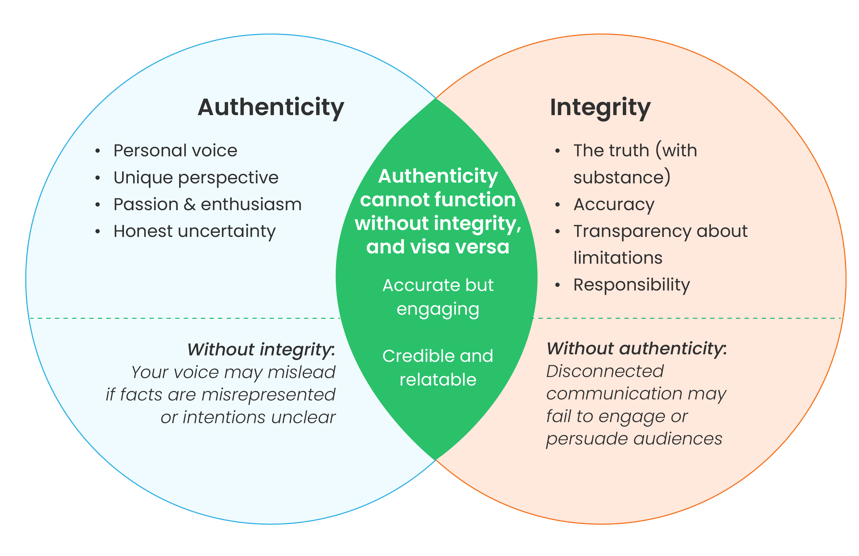
The first step in scientific communication is understanding the difference between integrity and authenticity – and being able to utilize both simultaneously. Integrity refers to truthfulness and transparency. Communicating with integrity builds trust and credibility by presenting facts, data, and analysis honestly while being transparent about risks, limitations, and uncertainties. Trust is a professional asset built through consistent, transparent communication. While uncertainty can reduce audience trust, being specific about where it lies and explicit about what is known versus what is unknown can improve transparency without impacting the overall message.1 When colleagues, clients, or leaders sense that communication reflects reality, they are more likely to extend trust, autonomy, greater access, and the benefit of the doubt. Even well-intentioned professionals can fall into habits that undermine communicative integrity, such as framing information selectively to steer decisions in a preferred direction. Maintaining integrity requires recognizing and avoiding these patterns in scientific communication.
Authenticity refers to one’s personal voice and unique perspectives and is reflected in the way scientific insights are communicated and align with one’s true values, feelings, and character, rather than performing or sounding “smart” or “impressive”. Effective communication comes from connecting with and understanding the audience rather than boasting about scientific results. Connection and authenticity draw audiences in and sustain their attention. It is important to note that being authentic is not the same as being unfiltered. Brené Brown, a professor who studies leadership, courage, and vulnerability, mentions in The Gifts of Imperfection: Let Go of Who You Think You're Supposed to Be and Embrace Who You Are that “Choosing authenticity means cultivating the courage to be imperfect, to set boundaries, and to allow ourselves to be vulnerable; exercising the compassion that comes from knowing that we are all made of strength and struggle; and nurturing the connection and sense of belonging that can only happen when we believe that we are enough.”2
Authenticity and integrity are often spoken of separately, but in reality, they are intertwined, and the presence of one without the other is incomplete. Without integrity, communication can mislead. Without authenticity, communication can feel disconnected and fail to engage audiences. Together, they enable communication that is both credible and relatable.
Source: Axtria Inc.
Written Communication
The Structure of Scientific Reports
Writing takes many forms in scientific communication, including manuscripts, white papers, study reports, protocols, conference posters, and more. Each of these follows a similar foundational structure. An executive summary or abstract follows the title. Even though it appears early in the document, this summary or abstract should be the last thing an author writes to ensure that it reflects the entire document. The executive summary or abstract is the most essential part of scientific communication because it is usually the first, and often the only, section audiences will read. Therefore, it should capture the essence of the entire report, including only key messages and components. Writing a refined executive summary or abstract takes practice and several rounds of review and refinement. It must be carefully crafted to do its job effectively.
Following the executive summary and abstract, the introduction defines clinical or scientific concepts, the therapeutic area, and relevant guidelines or recommendations. It should provide the study rationale, including relevant publications or previously conducted research. The introduction should conclude by outlining the research questions, hypotheses, and predictions, so the audience understands why the study was conducted and what the work addresses. The methods section should follow, describing the methodology used for data collection and data analysis. It is important to have a separate paragraph for each step in the methods, specifically for each analysis conducted.
The results section summarizes the data collected and presents only the results of analyses, without describing any reasoning for the outcomes. The discussion section follows, interpreting the testing of hypotheses and explaining how the results answer the research questions. This section explains the meaning of the data in the context of the hypothesis and discusses the strengths and limitations, including assumptions and caveats. Suggestions for future research can be included at the end of the discussion. A conclusion section may also be added after the discussion, although it is not always necessary, and typically summarizes the findings and insights in one or two succinct paragraphs. After the main sections of the report, acknowledgements, and references may follow.
Paragraph Structure: The MEAL Plan
Within a paragraph, a common technique for impactful writing is the MEAL plan, which includes the main idea, evidence, analysis, and link.3 The MEAL plan can improve the structure and flow of paragraphs in the main text, particularly in the methods, results, and discussion sections. Paragraphs should be three to eight sentences long and should start with the main idea – a topic sentence that does not include a citation. Evidence should follow, documenting research that supports the main idea of the paragraph. Analysis then interprets the evidence, drawing conclusions that connect the idea to the overall argument, and preparing the reader for the next paragraph. Following this structure of assertion, evidence, and analysis provide a consistent flow from one paragraph to the next.3
Formatting and Consistency
Consistent formatting is also essential. When consistency is not observed, audiences are drawn to these areas. Spelling errors, different font sizes and styles, uneven paragraph indentation, and similar inconsistencies can distract the audience from recognizing the value of the work being presented. In some cases, intentional variation in formatting may be used to emphasize a specific idea. Consistency should be followed from the beginning, and quality assurance must be performed at the end. Journal templates should be followed for manuscripts or abstracts, and internal templates should be followed for reports or other writing materials. If templates are not available, they should be developed, as they are essential for effective written communication.
Developing Scientific Manuscripts
Manuscripts are especially important in scientific communication, as they are considered the gold standard for peer-reviewed, accurate, and transparent findings. Developing figures and tables is often the first step in creating a comprehensive manuscript. Once figures and tables are developed, the storyline can follow, describing and interpreting the results and their implications for the broader community.
Presentations and Slide Decks
Presentations of all kinds are very common in scientific communication, potentially even more common than written reports, due to the lengthy review process required for manuscripts. Slide decks, when paired with verbal communication, are essential for conveying results effectively and efficiently. Compared to written communication, presentations are typically shorter and focus on refined messages and key components of a study. It is therefore essential that slide decks are crafted carefully and with intention.
Structuring a Scientific Presentation
Developing a slide deck should start with outlining and defining the key message. Laying out the slides one by one, with one idea per slide, helps organize the presentation's flow. Storyboarding is also essential, incorporating both horizontal and vertical logic. Horizontal logic refers to the slide titles, which should be read as a story throughout the deck. If someone received the slide deck and read only the titles, they should be able to understand the study as a whole. In many presentations, titles are only a few words, such as “Objectives” or “Background”, which are not impactful for audiences. Instead, titles should summarize the content concisely to allow for immediate comprehension.
Vertical Logic Within Slides
Vertical logic refers to the content within a slide, which should include only supporting evidence and present the necessary data or information for a single idea. The content should not be overcrowded, as overly packed presentations are difficult to comprehend. Refinement of each slide is essential. To refine a slide, it is essential to step back and determine what is crucial for the audience to understand the key message. Everything else should be removed.
Presenting Results Clearly
Using time efficiently helps maintain audience engagement and conveys value quickly. Avoiding redundancies, presenting the key message early, and prioritizing clarity help accomplish this goal. In most cases, deductive reasoning, which moves from broad to specific ideas, is more appropriate than inductive reasoning, which moves from specific ideas to broad ones. This structure requires less mental effort and allows ideas to be communicated more efficiently. To implement this approach, start with the key takeaway and follow with supporting messages and analyses. The conclusion should then recap this logic.

Source: Axtria Inc.
For slide decks, articles, and manuscripts, quantifying results is essential, as outcomes can easily be misinterpreted without clear numerical context. Statements should be supported by data whenever possible. If the data are unavailable, clearly state this, as the absence of data is itself informative. Scientific “failures” can be valuable for future success and may highlight opportunities for additional research to address data gaps. Audiences appreciate knowing where data is unavailable, particularly when this is communicated clearly and transparently. As in written communication, be consistent within and across slides. Consistency is visually appealing, and typos or errors can distract the audience from the work's value.
Data Visualization in Scientific Communication
Visuals, including figures and tables, are a key component of scientific communication. They help audiences quickly understand complex information in both written and slide-deck formats. Readers often review visuals before reading the full text, and in some cases, they may be the only elements examined. For this reason, visuals must be carefully designed to clearly and accurately communicate results.
Figures present graphical representations of relationships, trends, or processes. Effective figures highlight key data points and use clear visual cues such as color contrast, annotations, or arrows. Colors should be specifically chosen with intention, representing the ideas as a whole, such as green for a positive result. Axes, labels, and formatting should remain consistent across related figures to ensure clarity and comparability. Tables organize detailed numerical or categorical data for precise comparison. Well-designed tables present information concisely, allowing readers to quickly identify patterns or differences. Formatting, including alignment, spacing, and labeling, should remain consistent throughout to maintain readability and avoid distracting the audience from the data. Footnotes, assumptions, and abbreviations should be added to both figures and tables, and consistency should be maintained across all graphics.
Ineffective Table Design
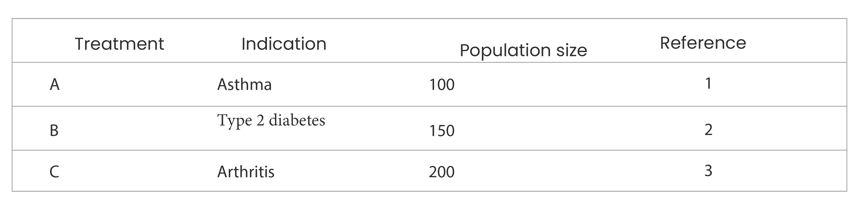
The table below includes several formatting issues. Some may be immediately apparent, while others are more subtle.
Source: Axtria Inc.
Effective Table Design
The following table shows the same content with formatting that supports clear and accurate interpretation.

Source: Axtria Inc.
Leveraging AI in Scientific Communication
Artificial intelligence (AI) can be used in scientific communication, but it must be applied with intent and transparency. The use of generative AI (GenAI) can result in time savings and create space for more strategic thinking. As of October 2023, 24% of the 100 largest publishers and 87% of the top 100 highly ranked journals provided guidance on the use of GenAI.4 To ensure compliance with these guidelines, authors should stay up to date with the most recent policies, especially when preparing a peer-reviewed manuscript. Most publishers and journals do not allow GenAI to be listed as an independent author, although many require disclosure when GenAI tools are used.
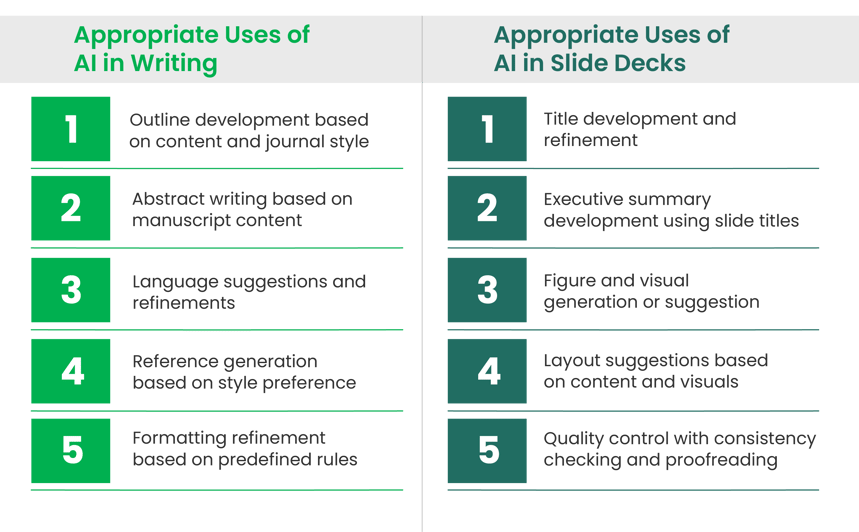
For written communication, AI can support outline development aligned with a journal’s style, abstract writing tailored to the manuscript's content, language suggestions and refinements, reference generation aligned with a preferred style, formatting improvements, and many other tasks. For slide deck generation, AI can assist with title development and refinement, executive summary generation, visual creation or suggestions, layout improvements, and quality control for consistency. It is essential that any confidential information is protected and not entered into AI models and that AI guidelines are followed in accordance with journal or regulatory recommendations. The following examples illustrate appropriate uses of AI in writing and slide development.
Source: Axtria Inc.
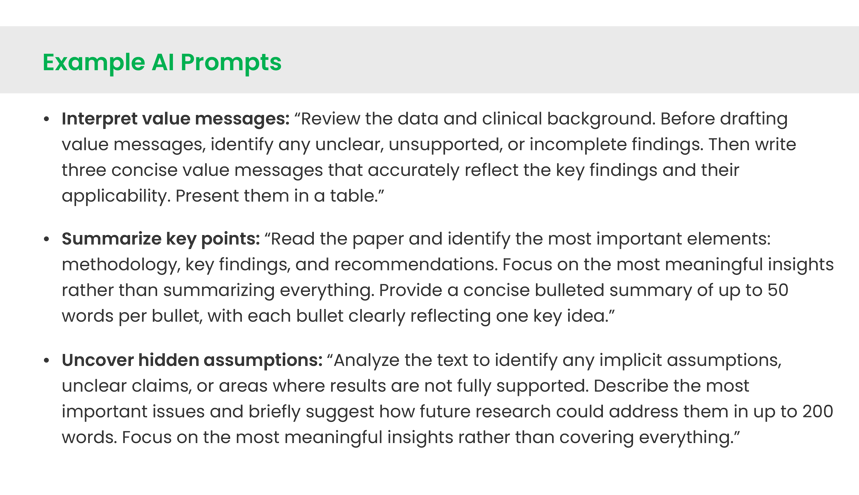
When using AI, authors must be explicit in their requests and use clear language. Models interpret instructions literally and cannot detect tone or sarcasm unless it is explicitly stated. After an output is generated, human interpretation is required to ensure the content is accurate, clear, complete, and concise. Human judgment and oversight cannot be replaced, and all outputs should be reviewed and verified. Several tools have been developed to support slide deck generation, including Beautiful.ai and SlidesAI.5,6
Example AI Prompts
Source: Axtria Inc.
Working with Scientific Communication Experts
Axtria’s RWE/HEOR/ES team has extensive expertise in scientific communication and medical writing and has assisted top pharmaceutical clients in producing manuscripts, abstracts, posters, and slide decks. The team has contributed to over 200 publications across multiple therapeutic areas in top-tier journals, including Human Reproduction Update,7 Journal of Medical Economics,8 and Blood Advances.9 In addition, Axtria’s RWE/HEOR/ES team has produced more than 50 abstracts and posters for various conferences, including ISPOR US and EU, AMCP, and Blood. For support with scientific communication needs, please contact Axtria.
References
- Full Fact. Communicating uncertainty [Internet]. Full Fact; 2020 [cited 2026 Feb 26]. Available from: https://fullfact.org/media/uploads/en-communicating-uncertainty.pdf
- Brown B. The Gifts of Imperfection: Let Go of Who You Think You're Supposed to Be and Embrace Who You Are. Center City (MN): Hazelden Publishing; 2010.
- Duke University Thompson Writing Program. The MEAL plan for paragraph structure [Internet]. Durham (NC): Duke University; [cited 2026 Feb 26]. Available from: https://twp.duke.edu/sites/twp.duke.edu/files/file-attachments/meal-plan.original.pdf
- Ganjavi C, Eppler MB, Pekcan A, et al. Publishers' and journals' instructions to authors on use of generative artificial intelligence in academic and scientific publishing: bibliometric analysis. BMJ. 2024;384:e077192. doi:10.1136/bmj-2023-077192
- Beautiful.ai. AI presentation software [Internet]. Beautiful.ai; 2026 [cited 2026 Feb 26]. Available from: https://www.beautiful.ai/
- SlidesAI. AI slide generator [Internet]. SlidesAI; 2026 [cited 2026 Feb 26]. Available from: https://www.slidesai.io/
- Munro MG, Salazar CA, Bhagavath B, Emanuel MH, Huddleston HG, Sobti D, Jaiswal AK, Gamburg R, Kumar J, Martin C, Hooker AB; Women’s Health Research Collaborative’s Endometrial Trauma Group. The epidemiology, clinical burden, and prevention of intrauterine adhesions (IUAs) related to surgically induced endometrial trauma: a systematic literature review and selective meta-analyses. Hum Reprod Update. 2025;31(6):588-625. doi: 10.1093/humupd/dmaf019.
- Wilson L, Martin C, Tripathi S, Dixit H, Miller J, Wang R, Lee WC. A budget impact analysis of the Dario Diabetes Solution for type 2 diabetes mellitus in a US managed care population. J Med Econ. 2025;28(1):1721-1732. doi: 10.1080/13696998.2025.2564575.
- Hall K, Lazaryan A, van der Laan M, Lee C, Logan AC, Gruber S, Kabadi S, Khan I, Nicholls C, Rota L, Nikai E, Ponomareva E, Koumas A, Waller EK. Efficacy and safety of belumosudil as compared with best available therapy for the treatment of cGVHD in the United States. Blood Adv. 2026;10(3):682-693. doi: 10.1182/bloodadvances.2025015832.
Author details
.jpg?width=225&height=225&name=image%20(8).jpg)
.png?width=210&height=225&name=image%20(6).png)
.png?width=225&height=225&name=image%20(7).png)
.jpg?width=225&height=223&name=image%20(9).jpg)