




Executive Summary
Pharma commercial organizations face a compounding challenge: HCP behavior, market access conditions, and competitive dynamics shift faster than traditional planning cycles can accommodate. Static segmentation, infrequent targeting reviews, and generic promotional messaging are no longer viable. The cost is measurable: misallocated field effort, eroding share in addressable segments, and strategies that are always one cycle behind the market.
This Point of View argues that the integration of Key Driver Analysis (KDA) and Dynamic Targeting (DT) resolves this challenge by creating a closed-loop commercial operating system. KDA provides the diagnostic clarity to understand what is driving performance and where interventions are needed. DT translates those insights into agile, persona-specific field strategies optimized for real-world constraints. Together, they give pharma commercial teams a way to connect broad diagnosis with local action and to sharpen both with each cycle.
KDA: The Diagnostic Backbone
Key Driver Analysis (KDA) is the analytical foundation of any performance-linked commercial strategy. It systematically identifies the probable causes behind brand performance variations and translates them into structured, actionable recommendations. Because market dynamics differ materially across geographies, KDA is applied at sub-national levels, such as state, district, or micro-cluster, to surface patterns that aggregate-level reporting reliably obscures.
What KDA Uncovers
A decline in new prescription (NRx) uptake, for example, rarely has a single cause. KDA organizes the diagnostic work across three dimensions:
- Access Barriers: Formulary restrictions, step-edit protocols, or prior authorization burdens concentrated in specific districts or payer segments.
- Promotional Efficacy: Mismatches between message content, channel mix, and HCP receptivity, particularly where digital engagement data diverges from claims trends.
- Segmentation Accuracy: Structural misclassification of HCPs that directs field effort toward low-potential targets while under-investing in high-potential ones.
KDA organizes these insights into a structured driver hierarchy, enabling decision-makers to connect broad performance signals to root causes and prioritize interventions with confidence.
Always-On Diagnostic Cadence
A single-point KDA is a retrospective exercise. Leading organizations treat KDA as an always-on or, at minimum, monthly process to capture emerging variations and attribute performance shifts accurately before they compound. This cadence transforms KDA from a backward-looking tool into a proactive diagnostic engine, one that ensures strategy evolves in step with market realities rather than lagging behind them by a quarter or more.
Dynamic Targeting: The Execution Layer
While KDA diagnoses performance drivers, Dynamic Targeting (DT) operationalizes the response. Traditional call planning relies on static HCP profiles and infrequently refreshed data, an approach that was inadequate even before digital engagement became a primary interaction channel. DT redefines the model, using recent behavioral and engagement signals to inform call plans on a monthly cycle.
The Monthly Optimization Engine
Each month, the DT system ingests updated datasets across six categories: sales performance, promotional effectiveness metrics, digital engagement signals, claims data, market access updates, and refined HCP profiles. These inputs feed into a framework of clustering and machine learning algorithms designed to optimize call plans within operational constraints, including team size, capacity, reach, frequency, and compliance requirements.
Dynamic Segmentation and Micro-Clustering
The DT process begins with dynamic segmentation, replacing static models that fail to capture evolving HCP behaviors. Monthly re-segmentation reflects the latest data, followed by micro-clustering to identify distinct HCP personas within each segment. These personas represent behavioral archetypes that require differentiated engagement strategies:
- Evidence-seekers: Data-driven prescribers who respond to clinical outcomes data and peer-reviewed evidence.
- High-engagement adopters: Early adopters with strong promotional responsiveness who can serve as advocates.
- Access-constrained prescribers: High-intent HCPs whose Rx behavior is structurally limited by formulary or prior auth barriers.
- Cautious skeptics: Low-engagement HCPs requiring confidence-building through multiple low-intensity touchpoints before conversion.
The Closed-Loop Integration
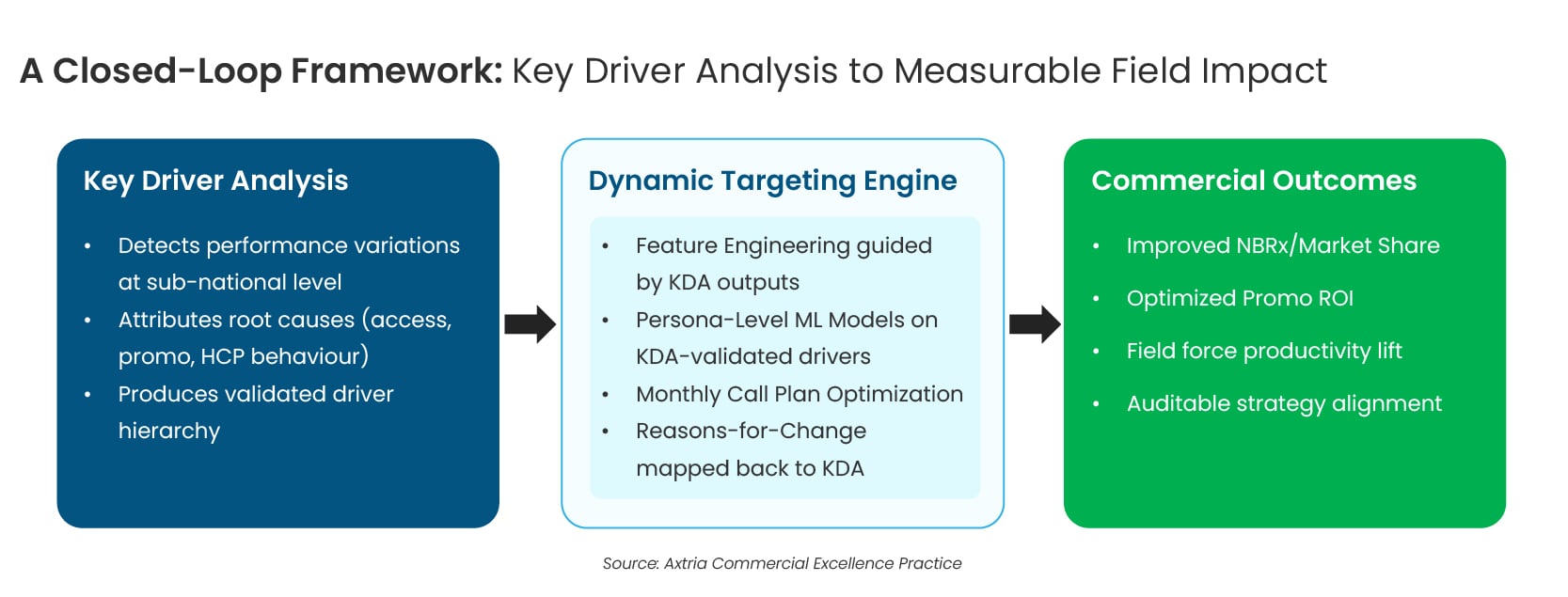
This approach differs not in KDA or DT in isolation, but in their systematic integration. When connected, they create a closed-loop operating system in which strategic diagnosis continuously informs tactical execution, and field results feed back to sharpen the diagnostic model.
The Integration Mechanism
After generating monthly DT call plans, organizations conduct a disciplined review of reasons for change. This involves mapping adjustments, such as shifts in HCP personas, changes in engagement efficacy, and improvements in market access, back to KDA outcomes. This verification process serves two purposes:
- Validation: When macro-level KDA diagnoses align with micro-level DT decisions and measurable outcomes improve, the system’s integrity is confirmed.
- Course Correction: When discrepancies arise, they signal the need to reassess KDA assumptions, investigate lagging effects, or refine persona model inputs.
Operational Imperatives
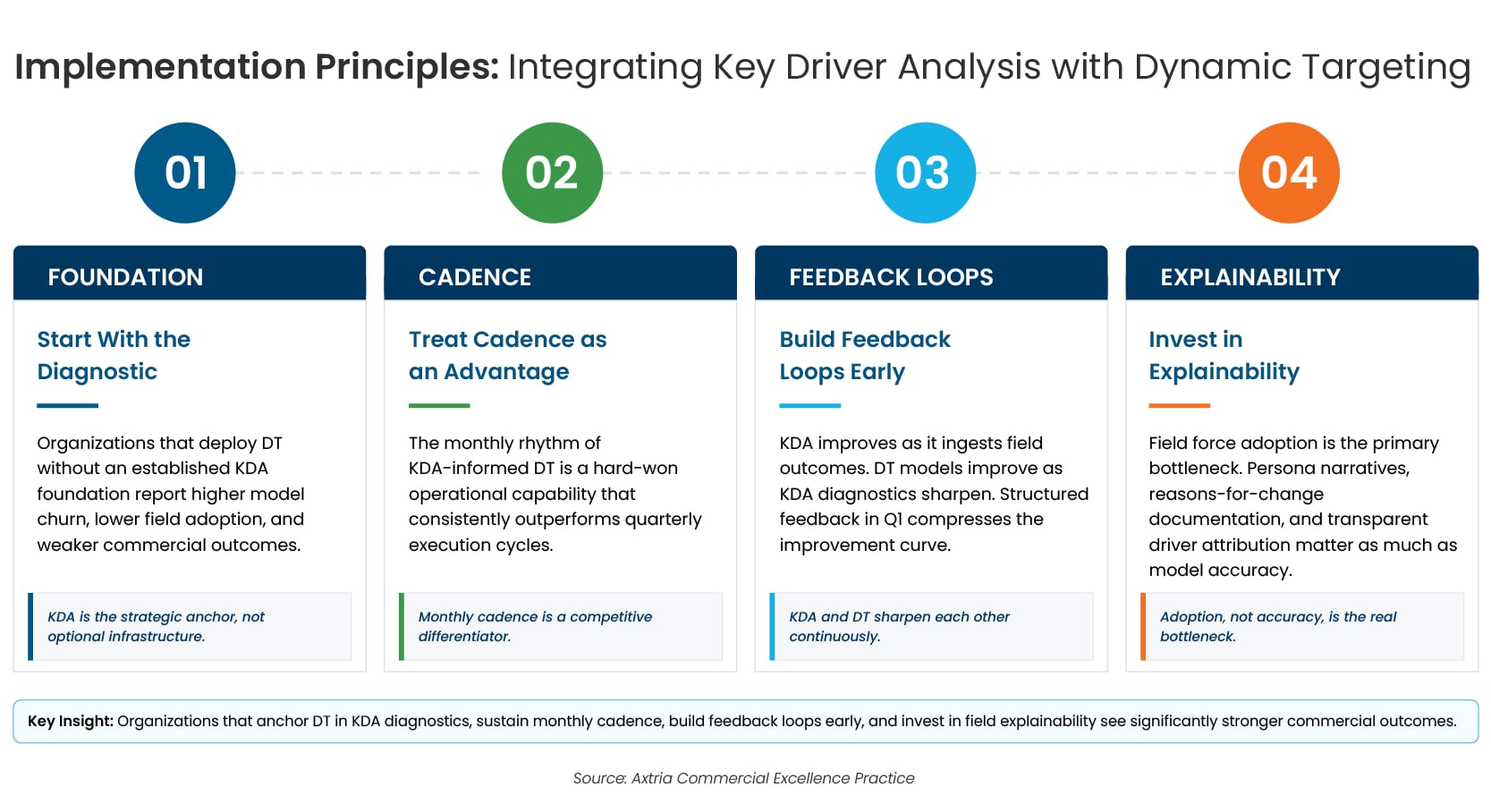
Integrating KDA and DT is an operating model transformation, not a technology implementation. The following imperatives determine whether the closed loop delivers sustained value or degrades into a data-processing exercise.
Conclusion
In an environment where HCP behavior, market access, and competitive dynamics evolve rapidly, static planning is no longer viable. Organizations that treat KDA and Dynamic Targeting as separate workstreams capture only a fraction of the value available. The integration of diagnostic intelligence with adaptive execution, operating on a common monthly cadence with explicit linkages between driver hypotheses and field actions, defines what leading commercial execution looks like in 2026.
The organizations that will win commercially in the next three to five years are those that transform brand management from a reactive, generic process into a proactive, personalized, and auditable operating system. KDA supplies the diagnostic clarity. DT delivers the execution precision. Together, they create a durable pathway to growth in an increasingly complex marketplace.
Bottom Line: Diagnose broadly. Act locally. Learn continuously. Optimize relentlessly. This is the operating model that KDA and Dynamic Targeting, integrated and sustained, make possible.
FAQs
Author Details