




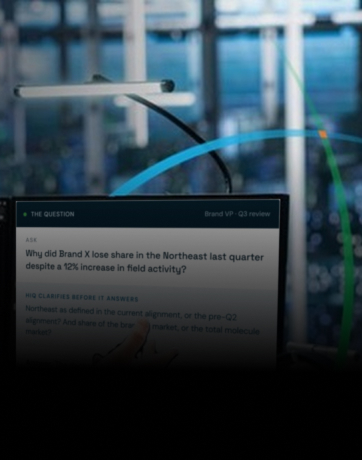
The digital knowledge worker for life sciences commercial teams.
Why now

Dashboards told you what happened. Agents will tell you why, but only if you can defend the answer.
Commercial teams are starting to hand their questions to AI agents instead of waiting on another report. An agent only helps if its answer holds up in a leadership review. That means using the metric definitions the business already approved, accounting for events like a mid quarter realignment, and showing where every number came from.
Three reasons the answer still isn’t there.

Too many tools. No single answer.
Leaders open five or more systems to resolve one question. The data is everywhere and the answer is nowhere, so reconciliation becomes the work instead of the prerequisite to it.
Leaders open five or more systems to resolve one question. The data is everywhere and the answer is nowhere, so reconciliation becomes the work instead of the prerequisite to it.

Every question becomes a ticket.
A quick ask turns into a queue position. Insight cycles stretch from minutes to weeks, and by the time the number arrives the window to act on it has closed.
A quick ask turns into a queue position. Insight cycles stretch from minutes to weeks, and by the time the number arrives the window to act on it has closed.

Generic AI
doesn’t know
your business.
A general-purpose copilot can read your schema. It can’t know that your alignment changed in Q2, that a plan moved tier in March, or that your organization counts new patient starts differently than the market does. It will answer anyway — fluently, confidently, and wrong in ways a business user has no way to catch.
A general-purpose copilot can read your schema. It can’t know that your alignment changed in Q2, that a plan moved tier in March, or that your organization counts new patient starts differently than the market does. It will answer anyway — fluently, confidently, and wrong in ways a business user has no way to catch.

Reliability is the product. Everything else is a feature.
We don’t ask you to trust the model. We make every answer checkable.
Your data never leaves your environment
No parallel copy, no data movement, no new security perimeter to certify.
Built to be questioned
When a question is ambiguous, HIQ asks before it answers. Ambiguity triggers a clarification, not a confident guess — which is the single most common failure mode of general-purpose analytics AI.
Deterministic where it matters
High-stakes governed KPIs run through deterministic calculation paths rather than probabilistic output. For those metrics, the same question returns the same answer every time — no drift between today’s number and tomorrow’s.
Full lineage. Full audit.
Every response exposes the sources, tables, joins, and filters behind it. SMEs can route, review, and approve. Compliance and IT can see exactly how an answer was assembled — and where to improve it.
Domain ontology, not generic AI
Pharmaceutical KPIs, hierarchies, channels, payer dynamics, and therapeutic-area context are already modeled — so HIQ interprets a commercial question the way your organization would, not the way the internet would.
It gets more accurate in your business, not in general
SME review routing and structured feedback loops tune HIQ against your definitions, your data, and your edge cases. Accuracy is measured on a validated question set maintained with your team.
Same data. Right lens.
HIQ knows the difference between a brand lead, a market access director, an analytics leader, a regional sales lead, and a commercial executive — and answers the question each one is really asking.
Brands
Market access
Field leadership
Commercial analytics
Commercial & data executives
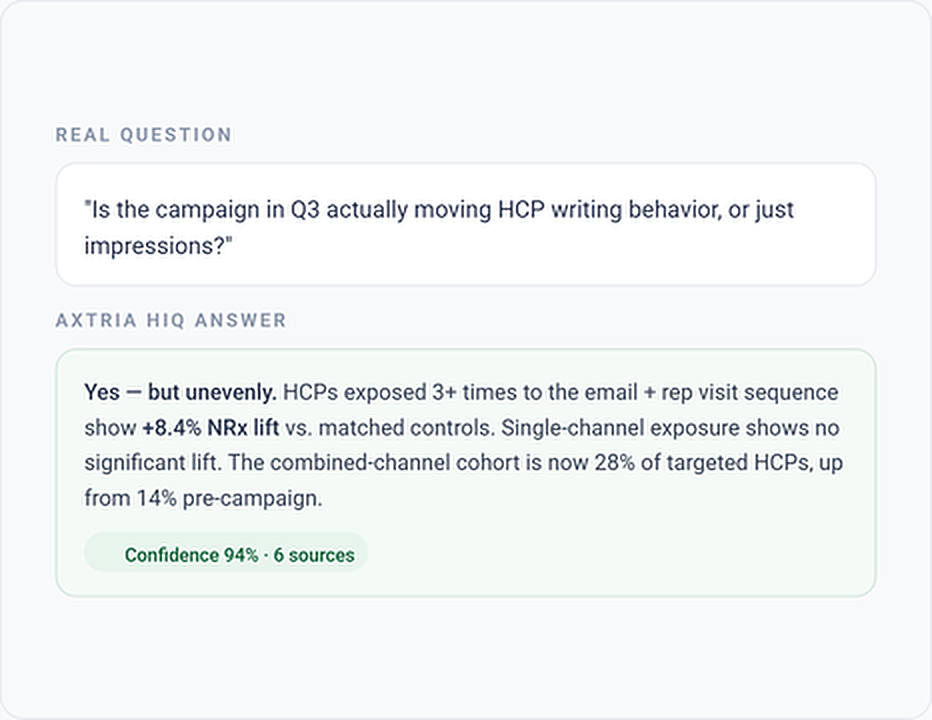
Know your brand the way an analyst would — without the wait.
Performance, HCP engagement, market dynamics, patient trends, and campaign effectiveness in one place. When the number moves, you get the story behind it before your next stand-up.
- What’s driving the variance to plan this week — and is it brand-wide or regional?
- Which high-value HCPs are declining faster than their segment, and is it engagement, access, or competitive?
- Is our growth coming from new patient starts or from persistence, and how does that compare to the market?
- How is the launch tracking against analog brands at the same point in their curve?
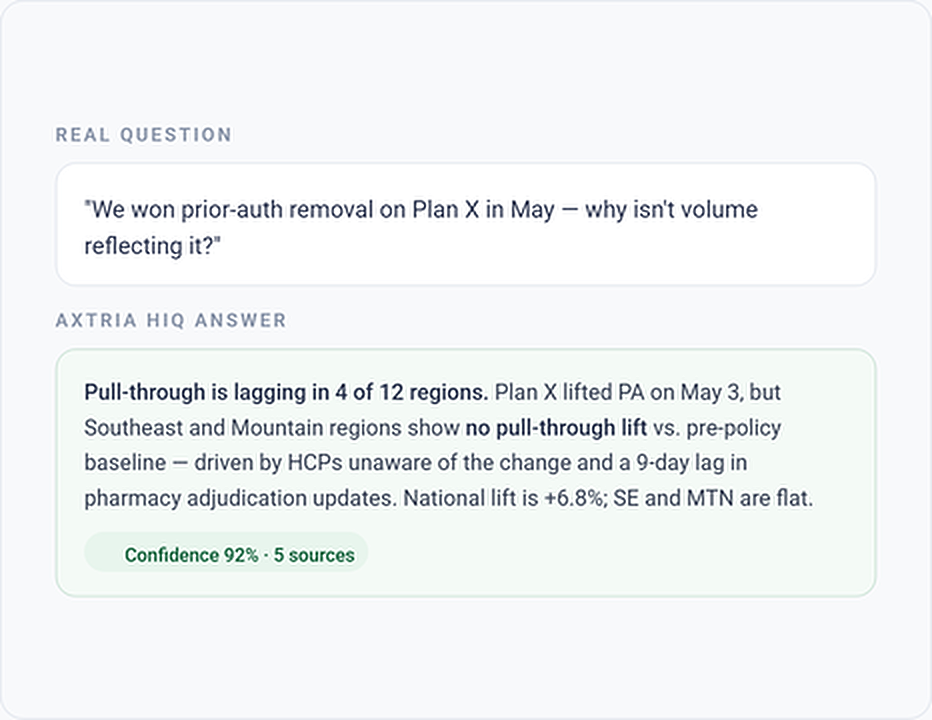
See the access landscape clearly — payers, formularies, pull-through.
Formulary movement, reimbursement dynamics, and pull-through performance across plans and regions, stitched together with your internal contract and claims data.
- Which plans moved tier this quarter, what volume is exposed, and where should we prioritize pull-through?
- Where have we won access but not converted it — and is the gap field execution, awareness, or patient affordability?
- How has payer access affected new patient starts across our highest-priority markets?
- What’s the rejection-and-rework rate by plan, and is it improving?
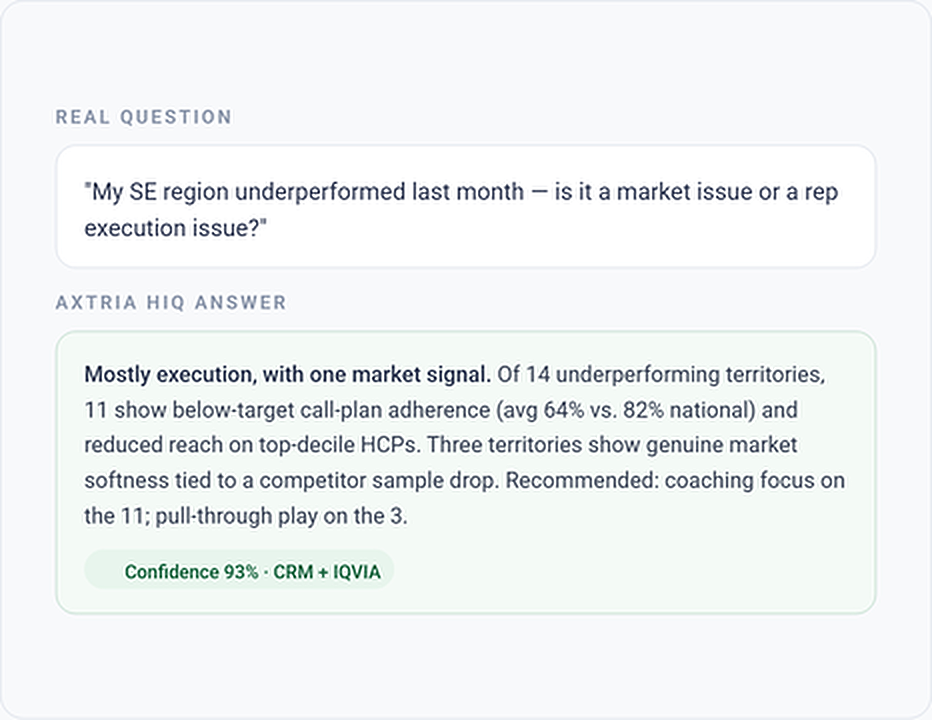
Coach what matters. Spot what’s slipping. Close the loop.
Territory performance, targeting gaps, and execution risk surfaced before the QBR — with enough context to know whether the problem is the rep, the plan, or the market.
- Which territories are underperforming relative to their opportunity, and how much of the gap is execution versus market?
- Where does call plan adherence actually correlate with growth — and where are we calling on targets that don’t respond?
- Did the realignment improve coverage of high-decile targets, or just redistribute existing calls?
- Which reps need coaching this week, and on what specifically?
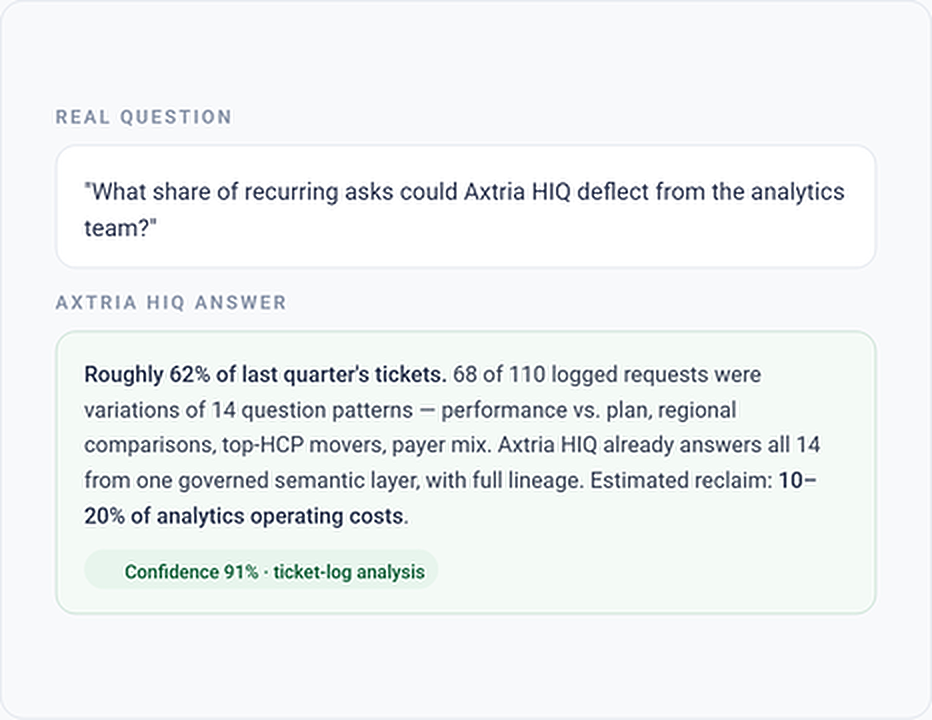
Own the source of truth. Get out of the queue.
HIQ absorbs the recurring asks and enforces your definitions everywhere they’re used. Your team stops reconciling and goes back to forecasting, modeling, and the work that actually requires an analyst. You govern the semantic layer — you don’t get replaced by it.
- Which questions are consuming the most analyst hours — and which can be self-served safely?
- Are KPI definitions consistent across brand, finance, and field, and where do they diverge?
- Where is data quality breaking, and how do I trace it to the source?
- Which answers did SMEs correct last month, and what did HIQ learn from them?
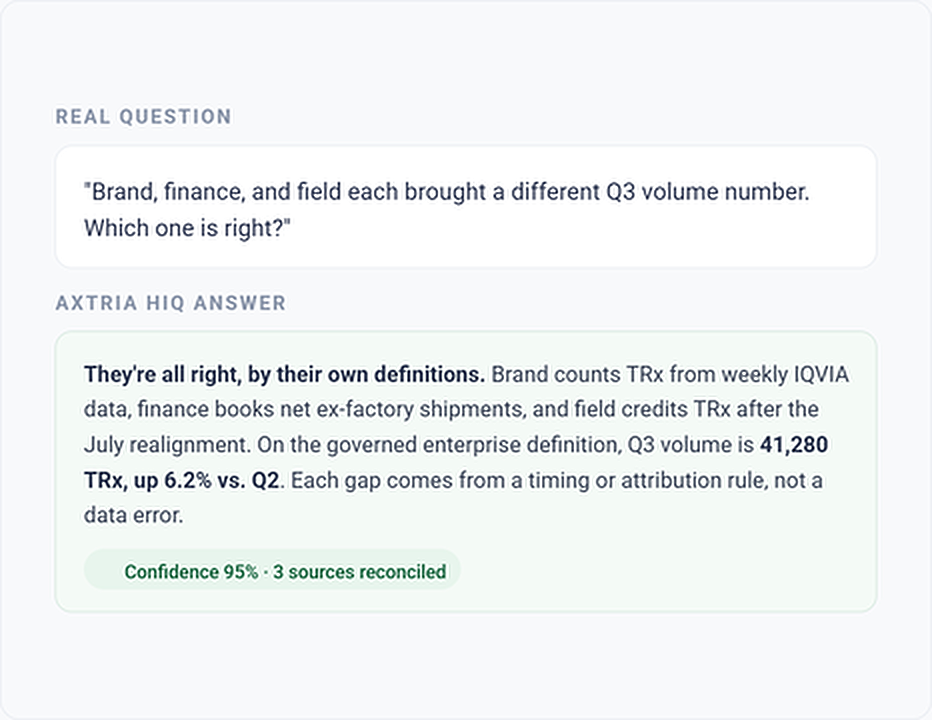
One number, agreed — before the meeting starts.
For commercial and data leadership: consistent metric interpretation across functions, decisions inside the quarter they matter in, and a governed path to AI that your security and compliance teams can actually approve.
- Where are we losing share, what’s causing it, and how much of it is recoverable this quarter?
- Which markets are underperforming relative to opportunity, and what would it take to close the gap?
- How much of our analytics capacity is spent answering questions that should be self-served?
- Can every number in this review be traced to source and reproduced on demand?
Know your brand the way an analyst would — without the wait.
Performance, HCP engagement, market dynamics, patient trends, and campaign effectiveness in one place. When the number moves, you get the story behind it before your next stand-up.
- What’s driving the variance to plan this week — and is it brand-wide or regional?
- Which high-value HCPs are declining faster than their segment, and is it engagement, access, or competitive?
- Is our growth coming from new patient starts or from persistence, and how does that compare to the market?
- How is the launch tracking against analog brands at the same point in their curve?
See the access landscape clearly — payers, formularies, pull-through.
Formulary movement, reimbursement dynamics, and pull-through performance across plans and regions, stitched together with your internal contract and claims data.
- Which plans moved tier this quarter, what volume is exposed, and where should we prioritize pull-through?
- Where have we won access but not converted it — and is the gap field execution, awareness, or patient affordability?
- How has payer access affected new patient starts across our highest-priority markets?
- What’s the rejection-and-rework rate by plan, and is it improving?
Coach what matters. Spot what’s slipping. Close the loop.
Territory performance, targeting gaps, and execution risk surfaced before the QBR — with enough context to know whether the problem is the rep, the plan, or the market.
- Which territories are underperforming relative to their opportunity, and how much of the gap is execution versus market?
- Where does call plan adherence actually correlate with growth — and where are we calling on targets that don’t respond?
- Did the realignment improve coverage of high-decile targets, or just redistribute existing calls?
- Which reps need coaching this week, and on what specifically?
Own the source of truth. Get out of the queue.
HIQ absorbs the recurring asks and enforces your definitions everywhere they’re used. Your team stops reconciling and goes back to forecasting, modeling, and the work that actually requires an analyst. You govern the semantic layer — you don’t get replaced by it.
- Which questions are consuming the most analyst hours — and which can be self-served safely?
- Are KPI definitions consistent across brand, finance, and field, and where do they diverge?
- Where is data quality breaking, and how do I trace it to the source?
- Which answers did SMEs correct last month, and what did HIQ learn from them?
One number, agreed — before the meeting starts.
For commercial and data leadership: consistent metric interpretation across functions, decisions inside the quarter they matter in, and a governed path to AI that your security and compliance teams can actually approve.
- Where are we losing share, what’s causing it, and how much of it is recoverable this quarter?
- Which markets are underperforming relative to opportunity, and what would it take to close the gap?
- How much of our analytics capacity is spent answering questions that should be self-served?
- Can every number in this review be traced to source and reproduced on demand?
What changes when the answer
doesn’t have to wait.

Recurring commercial questions are answered in minutes instead of reporting cycles — so course corrections happen inside the quarter they matter in, not after it.
Minutes, not cycles
Routine commercial questions, self-served

Time spent vetting, validating, and reconciling data goes back to forecasting, modeling, and the strategic work the team was hired for.
25–40% less
Analyst time spent validating and reconciling

Unified KPI definitions mean the meeting starts with the decision instead of the reconciliation — and the same question returns the same answer in every function.
10–15% better
Commercial execution efficiency from unified KPIs

Routine requests are self-served under governance, which lowers the cost of the analytics operation without lowering the standard of the answers.
10–20% lower
Analytics operating cost via self-served routine queries
Strategize better with our insights