


For thirty years, analytics tools have shown people the numbers and left them to work out what the numbers meant. That is the part that is now changing, and it and it ends in data that meets you where you are.
In Brief
- The old bargain. The software presented; the person did the thinking. Every tool generation made the presenting faster and left the thinking where it was.
- The shift. That thinking is now moving from the person to the system, from data you go and question to data that reasons on its own and reaches you first.
- What it looks like. The same change in the business arrives as a different, role-specific answer for each person who needs it, delivered before anyone types a question.
Picture how commercial decision making actually works today. A brand director sees sales dipped in the Northeast. She opens a dashboard, confirms the dip, and the real work begins. She pulls a second report to check volume versus price, a third to see which territories moved, then emails an analyst about a possible competitor launch. Two days later she has an answer. The dashboard showed her the what in five seconds. The why and the what-to-do she had to assemble herself.
That is the bargain pharma data analytics has always run on. The software presents, the person interprets. Every generation of tools made the presentation faster and prettier, but the hard half of the job, the thinking, stayed with the human. What is changing now is that the thinking itself is moving from the person to the system, until eventually the system stops waiting to be asked at all. For life sciences commercial teams, where the questions are tangled and good analysts are scarce, that is not a better dashboard. It is a different relationship with your own data.
A dashboard shows you what happened, not what to do
The core limit of every pharma data analytics tool built so far is simple to state. A dashboard can tell you what happened. It cannot tell you why it happened, what changed or What should I do about it. Those are the only questions anyone actually cares about, and they are exactly the ones left to the reader.
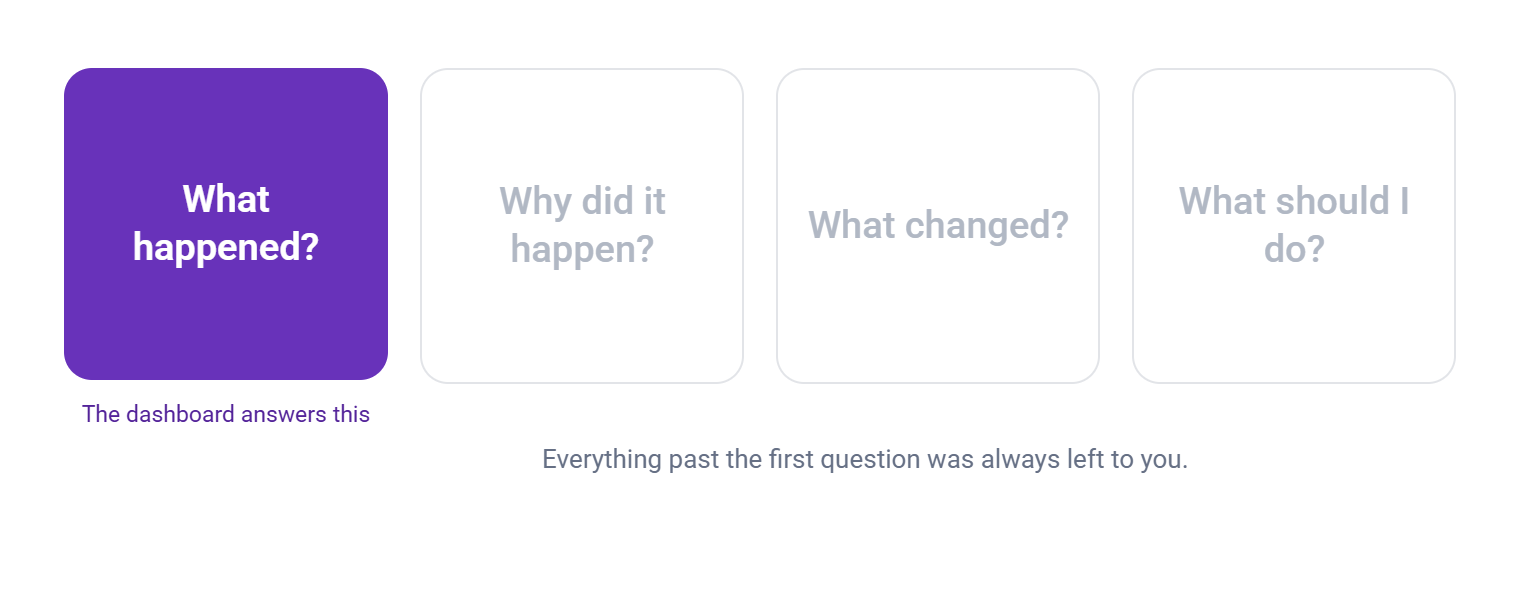 This is why commercial teams drown in dashboards and still wait on answers. The reports pile up, each one showing a slice, none of them connecting the slices into a conclusion. The analytics queue fills with requests, and the most valuable ones, the ambiguous questions that need real digging, sit behind routine data pulls. The tools are not broken. They were built to display information, and they display it well. Display was just never the thing that was hard.
Every tool so far got better at fetching, not thinking
Step back, and the whole history of analytics is one long improvement in how fast you can retrieve an answer you already knew to ask for. Static reports gave you a fixed answer on a schedule. Dashboards made it live. Self-service tools let you build your own query without waiting on IT. Conversational tools let you type the question in plain English instead of code.
Each step removed a barrier between the person and the number. Not one of them removed the barrier that matters most. In every case, you still had to know which question to ask, judge whether the answer was any good, and decide what to do next. The tool fetched. You reasoned. The shift underway is the first one that changes that, a system that does not just retrieve an answer but works its way to one.
What it actually means for a system to reason
Give a sharp analyst the question "why did we lose share in the Northeast last quarter." They do not open one report. They check whether the drop is volume or price, isolate which territories moved, and test a few explanations, a payer that tightened coverage, a message that stopped landing, a competitor that launched, keeping only the one that fits. They come back not with a chart but with a sentence: we lost share because two large plans added a coverage restriction in March, and here is where it is spreading next.
A reasoning system is built to do that whole sequence. It works out what the half-formed question is really asking, decides which analyses to run, follows the thread across several steps, and pulls in what a numbers-only tool never touches, the payer's policy language, a rep's field note, a call summary. Then it hands back the kind of answer a good analyst would, evidence attached. You are not handed a chart to interpret. You are handed an interpretation you can interrogate.
Data that talks to you
Now the part that changes the most, and the part that gives this piece its name. This is where pharma commercial data analytics stops being something you operate and starts working on your behalf. A system that can reason about a question can also work out which questions you care about, and bring you the answers on its own. This is what it means for data to talk to you. It stops being a place you go to look things up and becomes something that reaches out to you first.
Most people in commercial decision making roles ask the same twenty or thirty questions on a loop, set by what they are responsible for. A brand lead watches share and competitors. A field leader watches coverage and territories. A market access lead watches payer decisions. Those patterns are predictable. A system that knows them does not have to wait for you to log in and ask. It watches the data and brings the important change to you.
And it brings a different version to each person, because the same fact means different things to different roles.
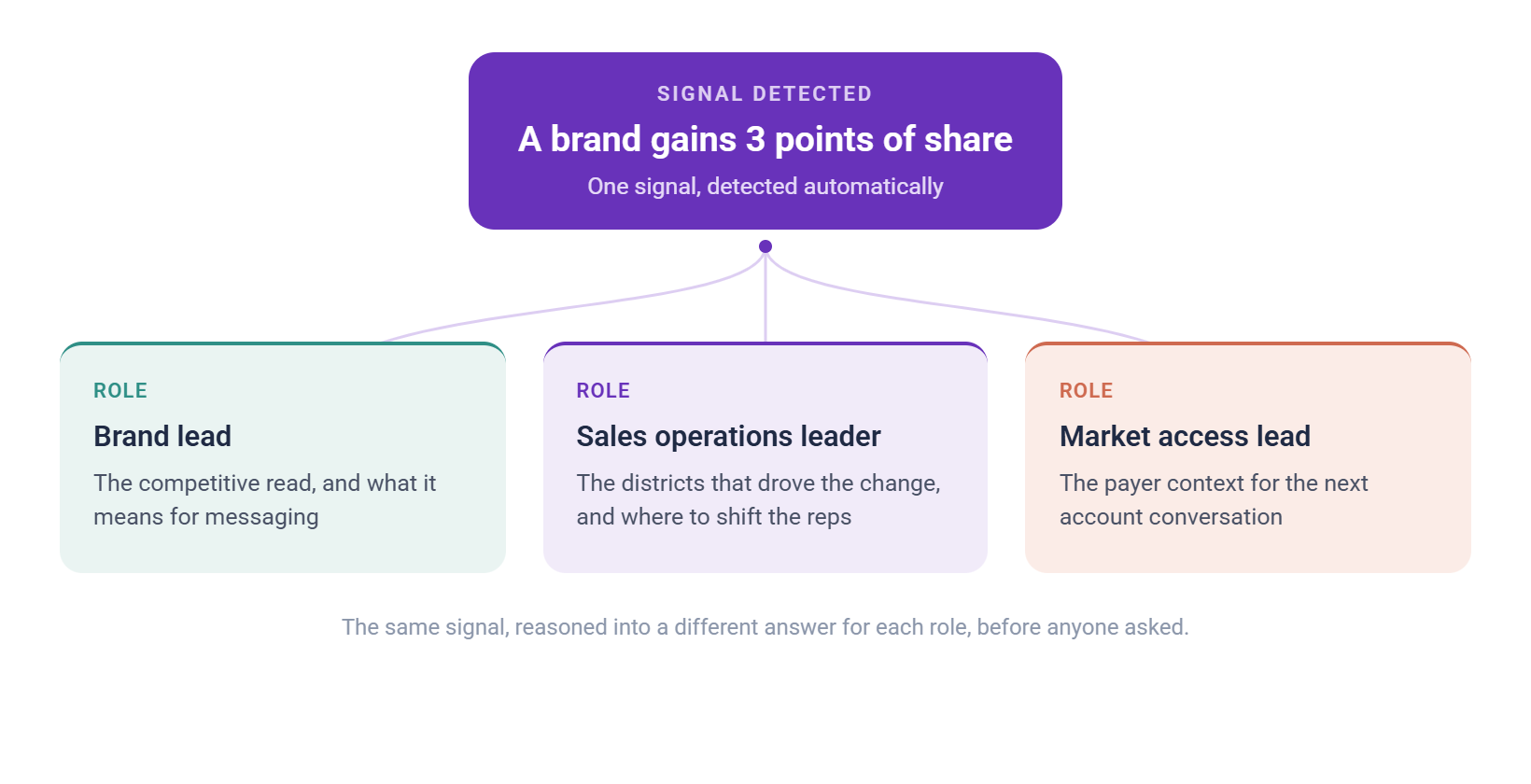
Say a brand picks up three points of share. The brand lead gets the competitive read and what it means for messaging. The sales operations leader gets the specific districts that drove it and where to shift the reps. The market access lead gets the payer context for the next account call. One event, three people, three genuinely different answers, each arriving before anyone typed a question. That is what it means for data to meet you where you are. Not a faster reply to your query. This is the idea behind any system built to reason about commercial data rather than just display it.
Getting an agentic analytics platform to do this reliably, across a real portfolio and not just a demo, is much harder than pointing a language model at a database. That is the subject of the second piece.
This piece draws on ideas presented at Axtria Ignite 2026.
FAQs
Author details